Translate

Showing posts with label ginkgoes. Show all posts

Friday, March 7, 2014

Working on the Pond

The ducks, cattails and water lilies were all floating on the pond in my last blog. I was happy with its appearance.
I fused everything in place, while still pinned to my design wall covered with white flannel.  Then decided, I needed a little more green to spill out into the border.  So I added two leaves in the lower right corner, you'll see that they are still pinned in place.

This last addition will be fused and the composition will be complete.

I've been thinking about a title for this quilt, and so far nothing great has come to mind.  Then it came to me:  On Ginkgo Pond.  The ducks will be Ethel and Norman, the main characters from the movie On Golden Pond.  I loved that movie. 

If I complete my thread work well, Ethel and her buddy should float around in their beautiful pond forever.  Now what should I quilt, embroider or applique?  After I have spent my entire career writing and teaching machine embroidery and quilting, I am over saturated with heavy thread work. I'm going to leave more open spaces so there will be texture changes across the surface of the finished quilt.

Ann's opinion:  I just visited a small show of art quilts, and we are over stitching everything.  Why?  I guess because we can; and historically the judges have always awarded more prizes to those quilts that are heavily quilted.  From my point of view, we're not allowing the batting to add dimension to the surface because everything is quilted too closely. Or maybe I'm just tired and grouchy!

Next time I'll show you some closeups of the thread work.

Ann Fahl

Friday, February 28, 2014

In the Middle there were Ginkgoes

The designing continues for this quilt. Over the last year or two I have been trying to use the ginkgo leaf in different ways. We last left the quilt with 2 ducks and some cattails and things were looking up.  The design phase wasn't complete, I just needed to tweak it a little more.
A few lily pads would fill the space without competing too much with the ducks.

I cut the lily pads from a hand painted green that I had painted several years ago.  There is a soft contrast between the cattails and the green pads.  I like the way it is looking.  And in the meantime, I've moved the lily pads here and there at least 10 times.
The pads cried out for a lily, so I made one out of white fabric and fused a bright yellow center. Oh yes, this is good.  Well, maybe one more flower is needed.
One more tiny lily has been placed in the upper left corner.  It will be moved around many times before it ends up in the right place.

Is it done?

Ann Fahl


Friday, February 21, 2014

In the Beginning there were Ginkgoes

Isn't this amazing?  Here is the background for my most recent piece, the above masterpiece was about 25 x 25 inches. 

Here's my vision for this small piece: a blue ginkgo leaf would become a pond for several mallard ducks. I thought the green would make a soft background for the blue leaf, with a simple pieced rectangle border added. The border would add some interest but not conflict with the central scene.

So I cut a large leaf 18 inches wide and placed it in the center of the background.
So far, so good, there is nothing to dislike about what I had done, so I painstakingly fabricated the two ducks out of multiple brown fabrics.
But I'm not happy with the relationship of the leaf to the background, it looks to small.  So I removed two edges of the border and made it smaller. It is now 22 x 22 inches.  I wanted the blue piece to overlap the border.
Then I decided I didn't like the first blue leaf, and cut a new one out of Frieda Anderson's hand dyed fabric.  I like this better because of the subtle shifts of color.
Now with the ducks resting in their new pond, I like the relationship of all the parts.  But it looks very empty.  What do I add next?
Cattails seemed to be a good addition and would work with my watery theme.  I cut them out of a piece of paper to decide on size and scale.  Their verticality was a nice contrast to the horizontal feeling of the large leaf and ducks.
Using a bright green for the leaves and tan for the cattails, I carefully cut out 3 clumps of cattails.  And I think this is good.  At this point, all the elements are only pinned in place.  I never fuse until the entire quilt top is all laid out, and I am sure it is good. I'm not sure what will happen next. It's not quite complete.

Tune in next week to learn more about this wall quilt.

Ann Fahl


Friday, February 14, 2014

A Little Ginkgo History

Photo of ginkgo leaves from wikipedia

My love of the ginkgo leaf comes from my long history with Winona Lake IN.  But the tree itself has a much looonger history.  The tree has been in existence since the Cretaceous and Jurassic periods, or 270 million years.  They have lived to see the dinosaurs live and die, and watched the evolution of plant and animal life up to the present day. There is no other plant like the ginkgo in existence today

It is the only tree that gets its water and sends it through one waterway up the trunk, instead of many small xylem and phloem inside the bark that modern trees use to deliver water and nutrients.  This is one reason why the leaf has such an interesting shape, different than all the others.

It is admired for its beauty, perhaps beginning in ancient China; used for medicinal purposes and as a food source. For a plant that is so old it has characteristics that have repopularized it today. It can be found in many urban settings, not just pampered gardens.  It can be very adaptive and disease resistant, which makes it perfect for roadside planting.
Everything is a little different with the ginkgo tree, even the way the leaves are attached to the limbs.

Here is an actual photo of one of my special trees.
These trees are very slow growers. I can only imagine the joy that people must feel if they have one growing near them.  The 2 ginkgoes at the swan pond were most likely planted about 1890, which would make them about 120 years old. This is the only photo I have of them.   

Another interesting fact is that in the fall, the leaves turn bright yellow, and most of them drop off the tree within 24 hours. So provide yourself with a lifetime of joy and plant a ginkgo tree.  Make sure you get a male variety because the females produce a very stinky fruit about the size of a cherry!

Or better yet, find a leaf and put it in one of your quilts!

Ginkgoes Galore, a quilt by Ann Fahl
 Ann Fahl

Friday, December 27, 2013

Belated Holiday Message

Christmas was difficult for me this year.  I just couldn't get in the mood. So right up to dinner on Christmas eve, I was still wrapping gifts, delivering them, shopping for last minute items etc. My style has always been prepare early, but this year I was a "goddess of the last minute," to borrow a phrase from Robbi Eklow.

Christmas is over, and I never finished getting ready. I need a nap.  But before I go upstairs for my nap,
I thought I'd share with you some of the Christmas tree quilts I've made in the past.

Ginkgo Christmas Tree 20 x 26 inches a pattern by Ann Fahl
Loving the ginkgo leaf I developed this little wall hanging. It's great for using up scraps.  I used a number of different green fabrics for the leaves, fused them onto the background and embroidered them with my favorite green variegated thread. Using the same thread on all the different fabrics helps to unify the quilt. A bright red 4 inch border gives it a holiday feeling.

Ginkgo Christmas Tree with Snowballs
Here is the same tree in a much smaller size. This time I've added little white snowballs over the embroidered surface. Because of its size it makes a great gift. This one is 9 x 12 inches.  You can lay this one on top of a piece of foam core and set it on a small easel to decorate for the holidays. You could also put the smaller size tree on a table runner or topper.

Christmas Jewels, 1988, made by Ann Fahl and Linda Honsberger 67 x 81 inches, hand quilted
To make a long story short, long ago, my friend Linda and I decided we'd make a sampler quilt together.  We purchased the fabrics at the same time. We each made 6 different blocks, making an extra of each to exchange. There were few rules, the blocks had to be 12 inches and use the fabrics we purchased, but we could set them together any way we wanted.  It was fun to see how they turned out. Linda's was very different than mine. She set hers with a lighter print, setting the blocks on square with 3 across and 4 down. (sorry no photos of hers.) Both the quilts were entirely hand quilted!
A closeup of the center medallion.
Behind the Christmas Tree, by Ann Fahl  24 x 30 inches
Some years ago, I was asked to demonstrate my machine embroidery techniques, so I took the ginkgo tree pattern and set it in a home environment.  I added a little Oreo, her favorite toy and a coneflower to fill the space. This demo piece turned out really well, so I quilted it, bound it and added it to my traveling cat show. You can read more about it by going to the link under the photo.
Here's the red and green tulip quilt again.
Here's the old quilt again, it is my current holiday quilt.  This time I am only 20 stitches short of finishing block 15 of the 20 on the quilt.  The left corner is in the worst condition of any on the quilt.  For the most part, the red fabric was in good shape, but this one edge is falling apart. Perhaps it was exposed to the most wear or sunlight.  As I get to a red border strip, I baste a thin strip of batting on top of the existing piece, and hand applique another red strip on top.  Eventually I will hand quilt over the new appliques.

There are still a few days left of this holiday season.  Have a wonderful one.

I'll see you next year!

Ann Fahl


Thursday, September 1, 2011

The Beauty of Variegated Thread


Red ginkgo leaf on table runner by Ann Fahl (c) 2011
Right now, I'm developing a new pattern for a table runner.  This is my first attempt to design a smaller project that a beginner might choose.  The runner has just 7 large Ginkgo leaves going down the center, with a few smaller leaves sprinkled in.  You can machine applique the leaves or use free-motion embroidery to hold them in place.  Eventually this pattern will be available on patternspot.com
Closeup of embroidery
 I completed the embroidery yesterday. Now I've been embroidering for years but the effects that variegated thread has on a project never ceases to amaze me.  How can you not love this red variegated thread on red fabric?
Really a closeup of embroidery on ginkgo leaf

Try a beautiful polyester or rayon variegated thread in your next project.  It adds a dimension that solid color threads do not.

If you are wondering which thread this is, it is Superior Threads Rainbow #832.

Tuesday, July 26, 2011

Trillium and Ginkgo Leaves

It seems to take forever to finish a quilt these days. This new one is called Trillium Landscape. It is small just 26 x 26 inches. I had to put it aside for awhile as I worked on some other things, so it has been in the works for months.

This is the third quilt that I have used the idea of setting my subject into another shape--a ginkgo leaf! This will make its debut at the LaConner Quilt and Textile Museum in LaConner, WA in October.
A closeup of Trillium Landscape

The trillium and leaves are heavily machine embroidered. I chose to use a curved and spiral combination of patterns as a contrast to the petal shape.
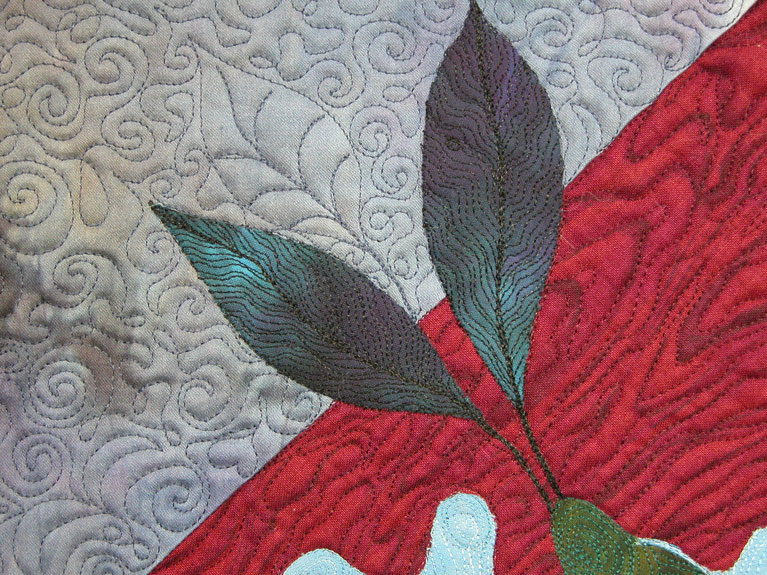
I love this little bud that rests on the right side of the ginkgo leaf.  You can also see the embroidery in the ginkgo leaf behind it.  My choice is always to use variegated thread. I try to have every variegated rayon or polyester thread in my studio.  I love the way it shines, this enhances the stitching. If you choose the correct needles for the free-motion work, you will have success with your embroidery.  Try using the new titanium topstitch needles.
This is a closeup of my signature on the front of the quilt. It needs to be there, but I try to choose a color or placement for it, so it doesn't draw the eye away from the subject.
Sometimes I like to repeat shapes from the subject in the quilting. You can see I've added a quilted leaf in the middle of the two embroidered leaves. Quilting should add surface interest to the quilt, but not be a distraction. For me it has to be fun, so I enjoy the process of quilting.

Ann