Translate

Friday, October 4, 2013

Where do I Begin?

These blocks are lovely and I've always liked the color choices the maker used.  I've made hundreds of quilts, done lots of hand work in my life, but never restored one like this. Where do I begin?
I think it is wise to remove one old piece at a time. The old stitching holes and pieces of old thread will mark the spot where I should sew the new piece on.  Beginning with the 3 center stems. The original maker used bias strips. So I constructed enough green bias all at one time to finish all 20 blocks.  I cut 1.5 inch strips, pressed them in half, then almost in half again to create .5 inch strips with both edges folded under, and easy to applique. I made 560 inches of bias! That should be enough to complete all the stems.

Next is the leaves. As I look at what is left of the blocks I see there isn't much consistency of size.  So I traced over the tiny leaves at the top and the larger leaves at the base to create plastic templates.  Wow, I haven't made templates in years.  I cut out enough just for several blocks so I can get going with my project. I'll cut more as needed.

Now the tulips, each consists of a red center and two green petals.  So I've done the same thing, made plastic templates and cut out enough for only 2 blocks.  I'm anxious to get going.
Tulip pieces in both red and green have been cut with scissors, like the original maker.
I will work in this order, removing all or portions of the damaged piece first:
  • Middle, right left stem
  • Lower green corner triangle
  • Middle red tulip piece, then 2 green side pieces
  • Tiny top leaves on both sides of the stems
  • Large lower leaves on each side of the stems

As I work, I'll pull out the old stitches and look for places on the front and back that may need repair.  I'll make those using some muslin that is well washed and matches the white background pretty well.

The quilt was appliqued with white thread.  This was done for many years, and was traditional to use white. But I love color and own thread in hundreds of colors so I will be appliqueing with matching red and green thread.

Hmmmm, each block times 20.  That's a lot of blocks.

Ann Fahl

Friday, September 27, 2013

Choosing the Fabrics

These are the new fabrics purchased for the restoration of this quilt.
You might say, "those fabrics look really dark!"  Well actually they are very close to the original color found on the underside of the old appliqued fabric.  I chose one that was a little richer in color rather than lighter than the original.

The fabrics are exactly what I was looking for, they are slightly mottled, so they'll blend in with the age of the quilt when washed.  The green fabric is from the Troy Corp, Riverwoods Collection, Modern Textures by Marcia Derse of mddesigns.  The red is called Solids for moda.

When I get home with my bag of fabric I want to begin right away. BUT:::::::::::the fabrics need to be rinsed out first.  I always do this with every fabric I own.  I rinse the fabric in hot water in my sink.  If it bleeds, I continue to rinse until the color is gone. Then it goes in the dryer. This prewashing accomplishes many things:
  • Removes excess fiber and lint from the fabric
  • Rinses off extra finishing chemicals from the fabric
  • Removes excess dye so color doesn't run onto the background or neighboring fabrics
  • When dried in the dryer, fabric may shrink so that the seams will be more stable and cause less puckering.
Only after this has been done, does a fabric go into my "stash."  It only takes one disaster for you to say, "Oh, why didn't I take the time............."

I've made my templates, cut a few tulips out,  and I'm ready to begin the hand stitching that I've been waiting for so long.  I can hardly wait to sleep under this quilt.

Let the journey begin.

Ann Fahl

Friday, September 20, 2013

The Red and Green Renovation Begins

Original border block of the Red and Green Tulip quilt.
Why am I spending the time to do this?  Not only do I love the quilt, but the white background and the quilting are in good shape.  The base is solid, only the appliques are falling apart.  So my thoughts are to remove the really bad parts, and just applique over all of the design, so the quilt looks consistent across the top. I plan on using this on my bed!

Off I go to the Sew 'n Save in Racine, they have a lovely fabric store next to their sewing machine shop.  I've decided that I need 2 yards of green and 3 yards of red fabric.  When matching old fabrics, I find it helpful to have a swatch to find the right colors.  Because there are so many bad spots on the applique, there were small places that I could cut off to expose the original color underneath. So this is what I took with me:
These are the little snippets of the actual fabric I took with me to match colors.
It didn't take long before I found the right fabrics. I'll show them to you next time.

Ann Fahl

My Loughry Grave Project


Jeremiah Lochry 1700-1749

When I first discovered Jeremiah’s gravestone on findagrave I thought to myself, “This headstone needs to be replaced.” His grave and cemetery information can be found there.  The opening page shows his 6 x great grandson near a small rock, which is all that remains of his grave marker. Mr. Lochry was the second person to be buried at the Lower Marsh Creek Burial Grounds in what is now Gettysburg PA. It is a very old cemetery and the Presbyterian Church nearby seems to be taking good care of it.
 Jeremiah's grave today
In 2011, I called the Presbyterian Church and asked them for a photo of the headstone, then contacted their historian, who led me to Codori Memorials in Gettysburg PA.  All this time we’ve been waiting for research to tell us how Jeremiah’s last name should be spelled. The Historical Society in Adams Co. did the work and we’ve determined it should be LOCHRY.  It has been spelled: Lockry, Lochra, Lochery, Loughry, Loughery, Loughrey, Lawry, Lowry, Lowery, etc. so there is reason for some confusion.

Jeremiah Lochry is ancestor #1 in the book titled A Brief Genealogy of the Loughry Family of Pennsylvania by Julia A. Jewett. He came from Ireland to America before 1740 with some of his family. He and his wife had 8 children; at least 5 came with him to the New World. They settled in what is now called Pennsylvania. Several of his sons fought in the Revolutionary War. His descendants are now too many to count, have gone on to accomplish many things. My mother’s family came from PA, and that it how I descend from Jeremiah. He is my 6 x great grandfather, he deserves more than just a remnant of a gravestone to mark his resting place.

Mr. Jim Codori has designed a new stone, taking into consideration the requirements of the ancient cemetery, for Jeremiah.  It says: “ Here Lies Jeremiah Lochry, Died December 1749, Founder of the Loughry Family.”  My goal is to have it in place in the spring of 2014 at the latest.
Planned grave marker 22 x 10 inches, level with the ground.

My plan was to ask all Loughry Family members for donations, but discovered the paperwork and tax implications would make that a difficult project. When I went to the bank to set up a "benefit" account, I had the ladies is tears telling them why I was doing this.  I like to keep things simple, so I am going back to my original plan, and will pay for the stone.  There may be some changes in the above proposed stone.  I will show you a photo of the stone, when it lies above Jeremiah.  This is just something that needs to be done.

This blog has been updated with new information here.

Ann Fahl

Friday, September 13, 2013

Saving an Old Quilt

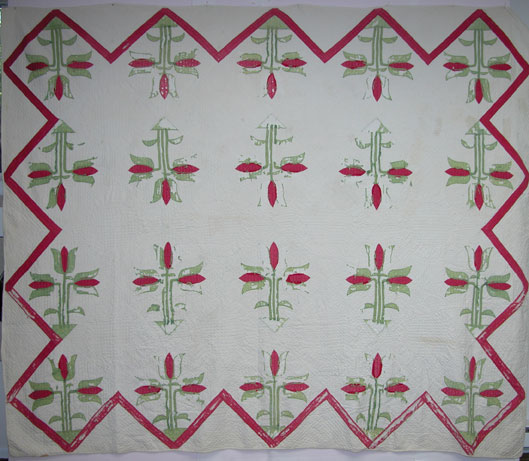
So here is the quilt, it's a big one, 85 x 102 inches.  The blocks, set on point are 14 inches square. The applique is by hand, and has been done and repaired by several hands.
Red and Green Tulips, a family quilt, no date or maker
As you can see, the red fabric is in much better shape than the green. The green can literally be just pulled off and it's in your hand.  More of it is gone, than present! The condition of the quilt is POOR. Because it is from the cottage, it is very special to me and worth spending the time to rescue.

What is the story of this quilt? No one living in my family knows anything about it.  But here is the story I have put together, based on a few facts. 

My great grandfather was one of the founders of a building and loan in Marion IN, he went to the same Presbyterian Church as Marie Webster. He was a good businessman and seemed to know lots about real estate ownership and management. Then the great Depression hit Marion and the USA.  He then became an owner of too many houses, and they all needed to be repaired and perhaps rented to keep the building and loan afloat. These years were difficult for everyone.

Grandpa must have taken some items in trade instead of rent, when the tenants couldn't pay. I think that is where this quilt came from.  This beautiful appliqued piece was something that had been treasured and had some value to the original owner, so it was given in lieu of rent. It had been well cared for and it was probably old at the time of the Depression. This is why I think it came from a family in Marion IN, but who knows where it was originally made.

Another theory is that when people left these homes, some of their belongings were left in the buildings. But I cannot see a woman leaving a precious quilt in a home she was leaving.  This still may have happened. I'll never know these details!

Grandpa bought the cottage in 1927 and owned it until about 1940.  Over the years all kinds of things turned up at the cottage, it had a big porch and living room and 4 bedrooms that needed to be furnished. This quilt was one of the things that was in the big trunk upstairs, and I've kind of grown up with it.

Now it is time to begin the time consuming task of repair. I'm looking forward to this part.

Ann Fahl